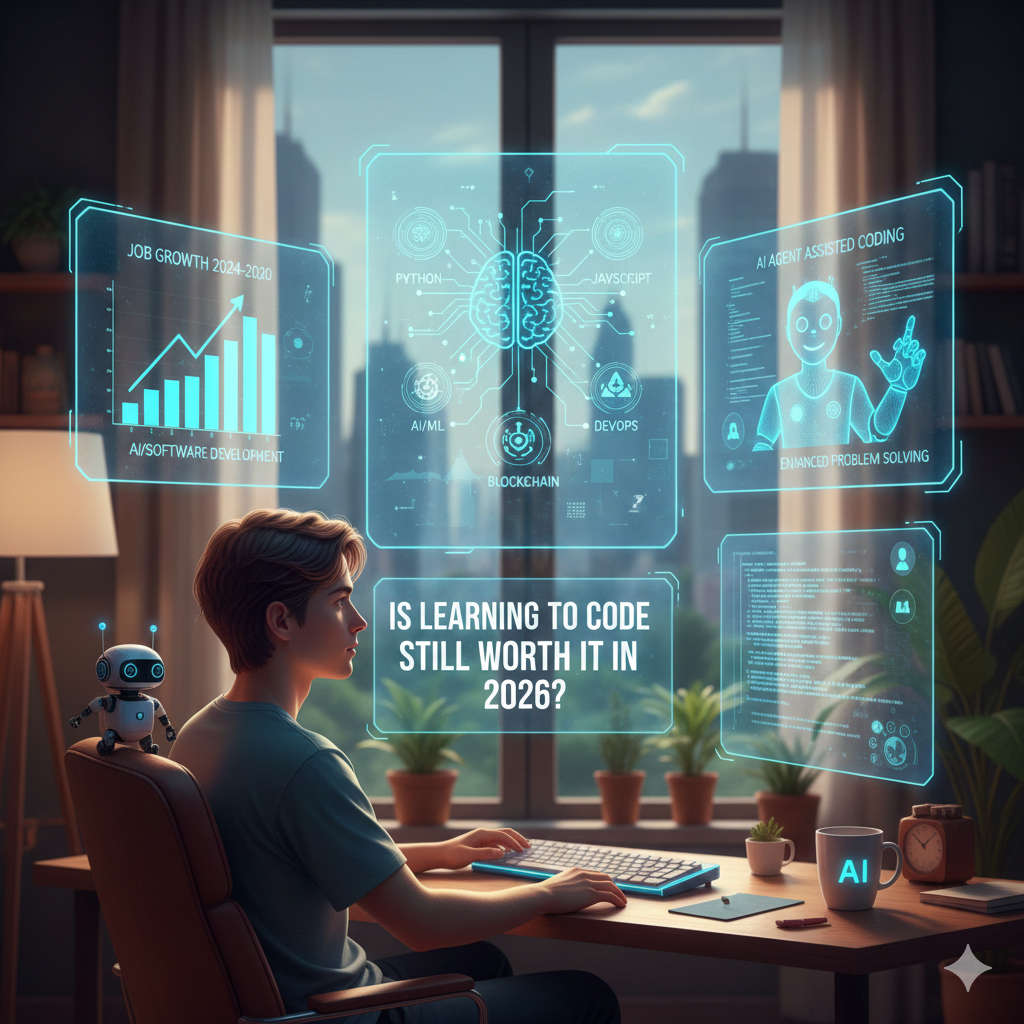
The question comes up everywhere in 2026.
Students ask it before choosing degrees.
Career switchers ask it before investing months of effort.
Even experienced developers quietly wonder about it late at night.
If AI agents can write code, debug applications, generate entire projects, and even deploy systems—does it still make sense to learn how to code?
It’s a fair question. AI has changed software development faster than almost any previous technology shift. What used to take teams of engineers now sometimes starts with a single person and an AI assistant. Tools that once felt magical are now everyday utilities.
But here’s the truth that often gets lost in the noise:
Learning to code is still worth it in 2026—but not for the same reasons it was ten years ago.
Coding hasn’t disappeared. It has evolved. And the people who understand that evolution are the ones who benefit the most.
This article explores what coding really means today, how AI agents are reshaping the field, which skills still matter, and how you can decide whether learning to code is the right move for you.
How AI Agents Have Changed Coding (And What They Haven’t Changed)
AI agents in 2026 are impressive. They can:
- Generate working code from plain language
- Fix bugs and refactor messy projects
- Suggest architectures and frameworks
- Write tests and documentation
- Translate code between languages
- Speed up development dramatically
For many people, this creates the impression that coding has been “solved.” That it’s now just a matter of asking the right questions and letting AI handle the rest.
But this view focuses only on output, not understanding.
AI Writes Code, But It Doesn’t Understand Problems Like Humans Do
AI agents operate by predicting patterns. They don’t truly understand business goals, user needs, trade-offs, or long-term consequences. They don’t own mistakes. They don’t feel pressure when systems fail. They don’t negotiate requirements or clarify vague ideas.
Humans still do all of that.
Coding has always been more than typing syntax. It’s about:
- Translating messy real-world problems into precise instructions
- Deciding what should be built, not just how
- Balancing speed, quality, cost, and risk
- Understanding why a system behaves the way it does
AI can help with execution. Humans still lead the thinking.
What “Learning to Code” Actually Means in 2026
One of the biggest mistakes people make is thinking learning to code means memorizing syntax.
That era is over.
In 2026, learning to code is really about learning how systems work.
Coding Is No Longer About Typing Faster
You don’t get paid for typing semicolons anymore. You get paid for:
- Understanding how data flows through systems
- Knowing where bugs might appear before they do
- Designing solutions that scale and don’t collapse later
- Making smart trade-offs under constraints
AI reduces the mechanical part of coding. That’s a good thing. It frees humans to focus on the parts that actually matter.
Coding Is Becoming a Thinking Skill
When you learn to code, you learn how to:
- Break big problems into smaller ones
- Think in steps and logic
- Anticipate edge cases
- Debug not just errors, but assumptions
- Communicate ideas precisely
These skills apply far beyond software development. They show up in product design, data analysis, operations, research, automation, and leadership.
That’s one of the strongest arguments for learning to code even if you never become a full-time programmer.
Why Coding Knowledge Still Gives You an Edge With AI
Here’s something that surprises many people:
The people who benefit most from AI agents are the ones who already understand coding.
AI Is Only as Good as the Person Using It
Anyone can ask an AI to “build an app.” Very few can:
- Notice when the AI makes subtle logic errors
- Detect security risks in generated code
- Improve performance bottlenecks
- Adjust architecture when requirements change
- Guide the AI toward better solutions over time
Without coding knowledge, you’re forced to trust the output blindly. With coding knowledge, AI becomes a powerful multiplier instead of a crutch.
Coding Turns You Into a Better AI Collaborator
Modern development often looks like this:
- You define the problem clearly
- You ask AI for a solution draft
- You evaluate, refine, and correct it
- You iterate until it’s production-ready
That middle step—evaluation and refinement—is where coding skills matter most.
AI can suggest. Humans decide.
Jobs and Careers Where Coding Is Still Extremely Valuable
Despite headlines predicting the “end of programming,” demand for people who understand code remains strong in 2026. The roles just look different now.
Software Engineers and Developers
Software engineers are no longer valued just for writing code, but for:
- System design
- Code quality and maintainability
- Debugging complex issues
- Integrating AI tools effectively
- Making architectural decisions
AI helps them move faster, not disappear.
Product Builders and Startup Founders
Founders who understand coding can:
- Build prototypes without waiting on others
- Communicate clearly with technical teams
- Make smarter product decisions
- Iterate quickly with AI assistance
Even basic coding literacy can dramatically increase independence.
Data Analysts, Scientists, and AI Practitioners
Data work still relies heavily on code for:
- Cleaning and transforming data
- Building custom models
- Validating results
- Automating pipelines
AI helps, but domain understanding and logic still matter.
DevOps, Cloud, and Platform Engineers
Infrastructure doesn’t magically manage itself. Coding skills are essential for:
- Deployment pipelines
- Infrastructure automation
- Monitoring and reliability
- Security configuration
AI assists, but human oversight remains critical.
Technical Managers and Leaders
Leaders with coding knowledge make better decisions. They can:
- Evaluate technical risks
- Understand timelines realistically
- Communicate effectively with engineers
- Avoid being misled by buzzwords
Coding literacy becomes a leadership advantage.
Why Learning to Code Still Pays Off Long Term
Short-term trends come and go. Long-term skills compound.
Coding is one of those compounding skills.
Coding Builds Transferable Mental Models
Once you understand how software systems work, learning new tools becomes easier. Languages change. Frameworks rise and fall. But the underlying ideas remain.
People who understand those foundations adapt faster than those who rely purely on tools.
Coding Gives You Control Over Technology
Without coding knowledge, technology happens to you.
With coding knowledge, you shape it.
You can automate repetitive tasks, build custom tools, and create solutions instead of waiting for them to exist.
That sense of control is valuable in any career.
Coding Protects You From Over-Automation Anxiety
Ironically, the people most afraid of AI replacing them are often the ones who don’t understand how it works.
Learning to code removes that fear. You stop seeing AI as magic and start seeing it as a tool—powerful, but limited.
Common Myths About Coding in the Age of AI
Let’s clear up a few misconceptions that keep people stuck.
“AI Will Replace All Programmers”
AI replaces repetitive tasks, not responsibility.
When systems fail, humans are accountable. When requirements are unclear, humans clarify them. When trade-offs arise, humans decide.
Programming jobs are changing, not disappearing.
“You Don’t Need to Learn Languages Anymore”
You don’t need to memorize everything, but understanding at least one language deeply still matters. It teaches you structure, constraints, and how computers actually execute instructions.
That knowledge makes every AI interaction better.
“Prompting Is Easier Than Coding”
Prompting looks easy until things break.
Good prompts require the same skills as good code:
- Clear thinking
- Precision
- Understanding of constraints
- Awareness of edge cases
Prompting without coding knowledge hits limits quickly.
How to Learn Coding Effectively in 2026
If you decide learning to code is worth it, the next question is how to do it right.
Start With One Language and Stick With It
Choose a language known for versatility and readability. Focus on fundamentals before jumping between tools.
Depth beats breadth early on.
Learn Core Concepts, Not Just Syntax
Pay attention to:
- Variables and control flow
- Functions and modularity
- Data structures
- Error handling
- Basic algorithms
These ideas matter more than the language itself.
Use AI as a Tutor, Not a Replacement
Ask AI to:
- Explain concepts in simple terms
- Walk through code step by step
- Show multiple ways to solve a problem
- Help debug your own attempts
Always try first, then ask for help.
Build Real Projects
Nothing teaches faster than building something that actually needs to work.
Start small:
- A personal website
- A simple automation script
- A basic app or tool you personally need
Then improve it gradually.
Learn to Read and Debug Code
Reading code written by others—and by AI—is just as important as writing your own.
Debugging is where real understanding forms.
Coding vs Not Coding: A Practical Comparison
Here’s the honest difference learning to code makes in 2026:
- Without coding, you rely on tools built by others
- With coding, you create or customize your own tools
- Without coding, AI feels unpredictable
- With coding, AI feels manageable
- Without coding, problems feel blocked
- With coding, problems feel solvable
Even basic coding knowledge dramatically expands what you can do with AI.
When Learning to Code Might Not Be Necessary
Coding isn’t mandatory for everyone.
If your work is entirely non-technical and you only need surface-level automation, learning how to use AI tools may be enough.
But even then, basic coding literacy often pays off in unexpected ways—especially as technology touches every field.
The Bigger Picture: Coding as a Life Skill
Coding in 2026 is less about becoming a programmer and more about becoming technically fluent.
It’s similar to learning how to write clearly. Not everyone becomes a novelist, but writing skills help everywhere.
Coding works the same way.
It teaches you how to:
- Think clearly
- Solve problems systematically
- Work with complex systems
- Communicate with both humans and machines
Those skills don’t expire.
Final Answer: Is Learning to Code Still Worth It in 2026?
Yes—if you learn it for the right reasons.
Learning to code is worth it because:
- AI makes coding more powerful, not irrelevant
- Understanding code improves how you use AI
- Coding builds thinking skills that transfer everywhere
- Technical literacy increases career flexibility
- The future rewards people who can guide technology, not just consume it
Coding isn’t dying. It’s maturing.
And in a world full of AI agents, the people who understand what’s happening under the hood will always have an advantage.
If you’re willing to learn, adapt, and think—not just type—then learning to code in 2026 isn’t just worth it.
It’s one of the smartest investments you can make.
Discover more from The Tech Passion
Subscribe to get the latest posts sent to your email.
 The Tech Passion