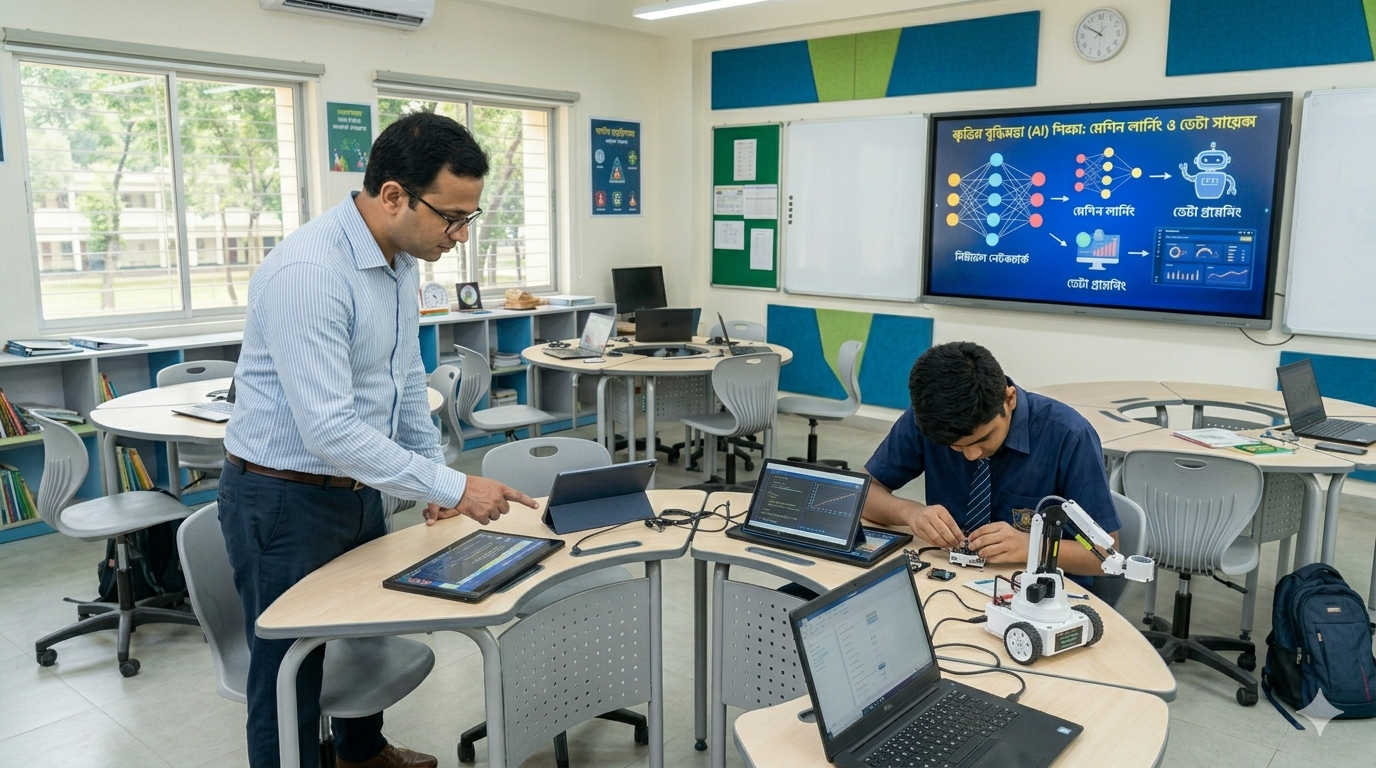
Artificial Intelligence (AI) is no longer a futuristic concept reserved for technology companies and research laboratories. It has become a part of everyday life. From personalized recommendations on social media and online shopping platforms to smart assistants, automated customer service, and advanced healthcare systems, AI is reshaping the way people live, work, and learn.
As the world enters a new era driven by data, automation, and intelligent technologies, education systems must evolve accordingly. Countries around the globe are investing heavily in AI education to prepare young learners for future careers and emerging challenges. For Bangladesh, introducing AI learning in secondary education is not merely an educational reform—it is a strategic investment in national development.
The students currently studying in secondary schools will become the workforce, entrepreneurs, policymakers, and innovators of the next decade. To compete in a rapidly changing global economy, they need more than traditional academic knowledge. They need digital literacy, critical thinking skills, computational thinking, and a basic understanding of artificial intelligence.
This article explores why AI education matters for Bangladesh, the challenges involved in implementation, and practical strategies for introducing AI learning in secondary schools across the country.
Why Bangladesh Needs AI Education in Secondary Schools
The demand for AI-related skills is growing worldwide. Organizations in every sector are adopting intelligent technologies to improve efficiency, solve complex problems, and create innovative services.
Bangladesh has already made significant progress in digital transformation through initiatives aimed at building a technology-driven economy. However, achieving long-term success requires developing human capital capable of creating and managing advanced technologies rather than simply consuming them.
Introducing AI education at the secondary level can help students:
- Understand emerging technologies
- Develop problem-solving abilities
- Build digital and computational skills
- Prepare for future careers
- Foster creativity and innovation
- Improve adaptability in a changing job market
AI literacy is becoming as important as computer literacy was two decades ago. Students who gain exposure to AI concepts early will be better positioned to succeed in higher education and future employment.
The Growing Importance of AI in Everyday Life
Many students already interact with AI without realizing it.
Examples include:
- Voice assistants on smartphones
- Language translation tools
- Personalized video recommendations
- Facial recognition technology
- Navigation and traffic prediction systems
- Online learning platforms
- Chatbots used for customer support
Because AI influences so many aspects of modern life, students should understand how these systems work, their benefits, and their limitations.
Teaching AI is not about turning every student into a software engineer. Rather, it is about helping young people become informed digital citizens who can navigate an increasingly technology-driven world.
Why Secondary Education Is the Right Stage for AI Learning
Secondary education is a critical period in a student’s intellectual development. During these years, learners begin to develop analytical thinking skills and explore potential career interests.
Introducing AI education at this stage offers several advantages.
Developing Critical Thinking Skills
AI learning encourages students to ask important questions:
- How do machines make decisions?
- What role does data play?
- Can technology be biased?
- How should AI be used responsibly?
These discussions promote critical thinking and deeper understanding.
Encouraging Interest in STEM Subjects
Many students lose interest in science and mathematics because they struggle to see real-world applications.
AI provides practical examples that connect classroom learning with real-life problems. Students can see how mathematics, statistics, and computer science are used to build technologies that impact society.
Preparing Students for Future Careers
The jobs of the future will increasingly require digital skills.
Even professions that are not directly related to technology—such as healthcare, agriculture, education, business, and public administration—are expected to use AI-powered tools.
Early exposure helps students make informed academic and career decisions.
Current Status of Technology Education in Bangladesh
Bangladesh has made notable progress in integrating technology into education.
The inclusion of Information and Communication Technology (ICT) subjects in secondary schools has helped students develop basic digital skills. Many educational institutions now have computer laboratories, internet access, and digital learning resources.
However, there remains a significant gap between basic ICT education and AI literacy.
Most students learn:
- Basic computer operations
- Microsoft Office applications
- Internet usage
- Introductory programming concepts
Very few are introduced to:
- Machine learning
- Data analysis
- AI applications
- Algorithmic decision-making
- Ethical implications of AI
As AI becomes increasingly important, this gap needs to be addressed through curriculum modernization.
Key Challenges to Introducing AI Education in Bangladesh
While the benefits are clear, implementation presents several challenges.
Limited Infrastructure
Many schools, especially in rural and remote areas, face infrastructure constraints.
Common challenges include:
- Insufficient computers
- Poor internet connectivity
- Limited digital resources
- Inadequate maintenance support
Without addressing these issues, AI education may remain concentrated in urban institutions.
Lack of Trained Teachers
Teacher readiness is one of the most significant barriers.
Most secondary school teachers have not received formal training in:
- Artificial intelligence
- Machine learning
- Data science
- AI-based educational tools
Without proper professional development, teachers may struggle to deliver AI-related content effectively.
Curriculum Overload
Students already follow demanding academic schedules. Adding entirely new subjects could create additional pressure.
Therefore, AI concepts should be integrated thoughtfully into existing subjects before introducing specialized courses.
Financial Constraints
Large-scale implementation requires investment in:
- Teacher training
- Digital infrastructure
- Learning materials
- Educational software
- Assessment systems
Careful planning is necessary to ensure sustainability.
A Practical Roadmap for Introducing AI Learning
Successful implementation requires a gradual and structured approach.
Phase One: Strengthen Digital Literacy
Before students can understand AI, they need a strong foundation in digital skills.
Key learning areas should include:
- Computer literacy
- Internet safety
- Basic coding
- Data handling
- Digital communication
- Cybersecurity awareness
These foundational skills create the groundwork for future AI learning.
Phase Two: Introduce AI Awareness
At the lower secondary level, students should learn AI concepts through engaging and accessible methods.
Topics may include:
- What is artificial intelligence?
- How AI is used in daily life
- Benefits and risks of AI
- Examples of AI applications
- Human versus machine intelligence
The goal is to build curiosity and awareness rather than technical expertise.
Phase Three: Hands-On Exploration
Students learn best through practical experience.
Schools can introduce activities such as:
- Building simple chatbots
- Exploring image recognition tools
- Using beginner-friendly coding platforms
- Conducting data analysis exercises
- Creating AI-based classroom projects
Hands-on learning makes abstract concepts more understandable and memorable.
Phase Four: Advanced AI Learning
At higher secondary levels, students can explore more sophisticated topics.
These may include:
- Machine learning fundamentals
- Neural networks
- Computer vision
- Natural language processing
- Data science principles
- AI ethics and governance
Advanced modules can be offered as elective courses or integrated into ICT curricula.
Designing an Effective AI Curriculum
An effective AI curriculum should prioritize understanding over memorization.
Lower Secondary Level (Grades 6–8)
Learning objectives:
- Understand basic AI concepts
- Recognize AI applications
- Develop computational thinking
- Build digital confidence
Suggested activities:
- Interactive demonstrations
- Educational games
- Group discussions
- AI-themed projects
Secondary Level (Grades 9–10)
Learning objectives:
- Learn introductory programming
- Understand data and algorithms
- Explore simple AI models
- Develop analytical skills
Suggested activities:
- Coding projects
- Data visualization exercises
- AI simulations
- Problem-solving challenges
Higher Secondary Level (Grades 11–12)
Learning objectives:
- Build and evaluate AI models
- Analyze ethical implications
- Conduct independent projects
- Explore career opportunities
Suggested activities:
- Research assignments
- Innovation competitions
- Industry collaborations
- Community-based technology projects
Teacher Training: The Foundation of Success
No AI education initiative can succeed without skilled teachers.
Comprehensive Professional Development
Training programs should focus on:
- AI fundamentals
- Classroom implementation strategies
- Digital learning tools
- Ethical AI principles
- Project-based teaching methods
University-School Partnerships
Universities can play an important role by:
- Providing training workshops
- Developing teaching resources
- Offering mentorship programs
- Supporting curriculum development
Continuous Learning Opportunities
Teachers should have access to:
- Online certification programs
- Webinars
- Professional learning communities
- Educational technology conferences
Continuous learning ensures educators remain updated as technologies evolve.
The Role of Government and Policymakers
Government leadership is essential for successful implementation.
Develop a National AI Education Framework
A national strategy should clearly define:
- Learning outcomes
- Curriculum standards
- Teacher competencies
- Assessment methods
- Infrastructure requirements
Launch Pilot Projects
Pilot programs allow policymakers to:
- Test curriculum effectiveness
- Gather feedback
- Identify challenges
- Refine implementation strategies
Increase Investment in Educational Technology
Funding should prioritize:
- School infrastructure
- Teacher training
- Educational content development
- Technology access in underserved regions
Encourage Public-Private Collaboration
Technology companies can contribute expertise, software, mentorship, and learning resources to support implementation efforts.
Teaching AI Ethics and Responsible Technology Use
AI education should not focus solely on technical skills.
Students must also understand the social and ethical implications of technology.
Privacy and Data Protection
Learners should understand:
- How personal data is collected
- Why privacy matters
- Responsible data usage practices
Fairness and Bias
Students should explore how biased data can produce unfair outcomes and why inclusive AI development matters.
Transparency and Accountability
Discussions about responsibility and decision-making help students think critically about the impact of technology on society.
Human-Centered Innovation
Technology should improve human well-being rather than replace human judgment in critical situations.
Encouraging Innovation Through Student Projects
One of the most effective ways to teach AI is through real-world problem solving.
Students can develop projects related to:
- Smart agriculture
- Climate monitoring
- Healthcare accessibility
- Disaster prediction
- Waste management
- Educational support systems
These projects encourage creativity while helping students understand how technology can address local challenges.
Learning from International Best Practices
Several countries have successfully integrated AI into school education.
Key lessons include:
- Start with AI awareness before technical specialization.
- Invest heavily in teacher training.
- Use project-based learning approaches.
- Ensure equitable access to resources.
- Emphasize ethics alongside technical skills.
Bangladesh can adapt these lessons while developing solutions suited to local realities and educational priorities.
Measuring the Success of AI Education
Introducing AI into schools should be accompanied by clear evaluation mechanisms.
Success indicators may include:
- Student engagement levels
- Teacher competency improvements
- Number of AI-related school projects
- Increased STEM enrollment
- Improved digital literacy rates
- Participation in innovation competitions
Regular assessment helps ensure that programs remain effective and relevant.
The Long-Term Benefits for Bangladesh
The impact of AI education extends far beyond the classroom.
A generation equipped with AI literacy can contribute to:
- Economic growth
- Technological innovation
- Increased productivity
- Better public services
- Research and development
- Global competitiveness
By investing in AI education today, Bangladesh can build a workforce capable of leading future digital transformation initiatives.
Conclusion
Artificial Intelligence is reshaping the global economy, transforming industries, and creating new opportunities at an unprecedented pace. As Bangladesh moves toward a more technology-driven future, preparing students with AI knowledge and digital skills is becoming increasingly important.
Introducing AI learning in secondary education is not simply about teaching advanced technology. It is about empowering students to think critically, solve problems creatively, and participate confidently in a rapidly evolving world. Through strategic curriculum development, teacher training, infrastructure investment, and strong policy support, Bangladesh can create an education system that prepares young people for the opportunities and challenges of the twenty-first century.
The students sitting in classrooms today will shape Bangladesh’s future tomorrow. Equipping them with AI literacy, ethical awareness, and innovation skills will ensure they are not only ready for the future but capable of creating it.
Discover more from The Tech Passion
Subscribe to get the latest posts sent to your email.

